Heterogeneous Chemistry and Photochemistry of Mineral Oxides and Engineered Nanoparticles in Atmospheric Aerosol
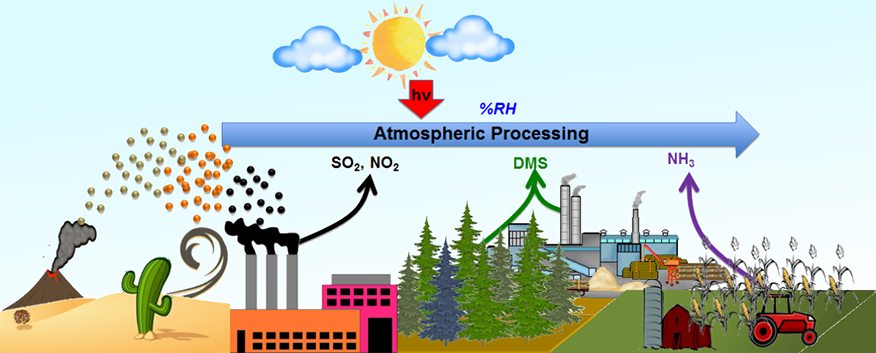
Mineral dust is one of the most abundant aerosol types in the troposphere, with global emissions estimated at 1,000–3,000 Tg per year — and rising as land-use pressures intensify. Once airborne, mineral oxides and engineered nanoparticles do not simply scatter light and seed clouds: they serve as reactive surfaces where heterogeneous and photochemical reactions with trace atmospheric gases fundamentally alter the composition of the atmosphere. These surface-driven reactions influence the cycling of nitrogen oxides (renoxification), the oxidation of SO₂ to sulfate, the decomposition of ozone, and the formation of secondary organic aerosol — processes with direct consequences for air quality, human health, and global climate forcing. Despite this outsized importance, the mechanistic underpinnings of these reactions — how they depend on relative humidity, temperature, and solar flux, and how they compare in rate and significance to gas-phase pathways — remain incompletely understood.
Our laboratory conducts mechanistic, molecular-level studies of the surface chemistry and photochemistry of mineral oxide aerosol particles and engineered nanoparticles under rigorously controlled environmental conditions. By independently varying relative humidity, temperature, and simulated solar flux, we isolate the drivers of each reaction pathway, quantify uptake coefficients and product distributions, and establish the kinetic data needed to evaluate the atmospheric significance of heterogeneous reactions relative to competing gas-phase routes. These findings provide molecular-level insights to interpret field observations and supply reaction parameters for incorporation into regional and global atmospheric chemistry models.
ADMINISTRATIVE ASSISTANT
GAYAN R. RUBASINGHEGE
Associate Professor of Chemistry
New Mexico Institute of Mining and Technology
Department of Chemistry
801 Leroy Place
Socorro, NM 87801
Bethany Jessen
New Mexico Institute of Mining and Technology
Department of Chemistry
801 Leroy Place
Socorro, NM 87801
Phone: 575-835-5129
Fax: 575-835-5215
Phone: 575-835-5263
Fax: 575-835-5364
Copyright © 2018 The Environmental Chemistry Research Research Group. All rights reserved.